
Before committing to ERP replacement, establish the business case
Frustration with your current ERP is a reason to investigate. The decision to replace it needs a business rationale.
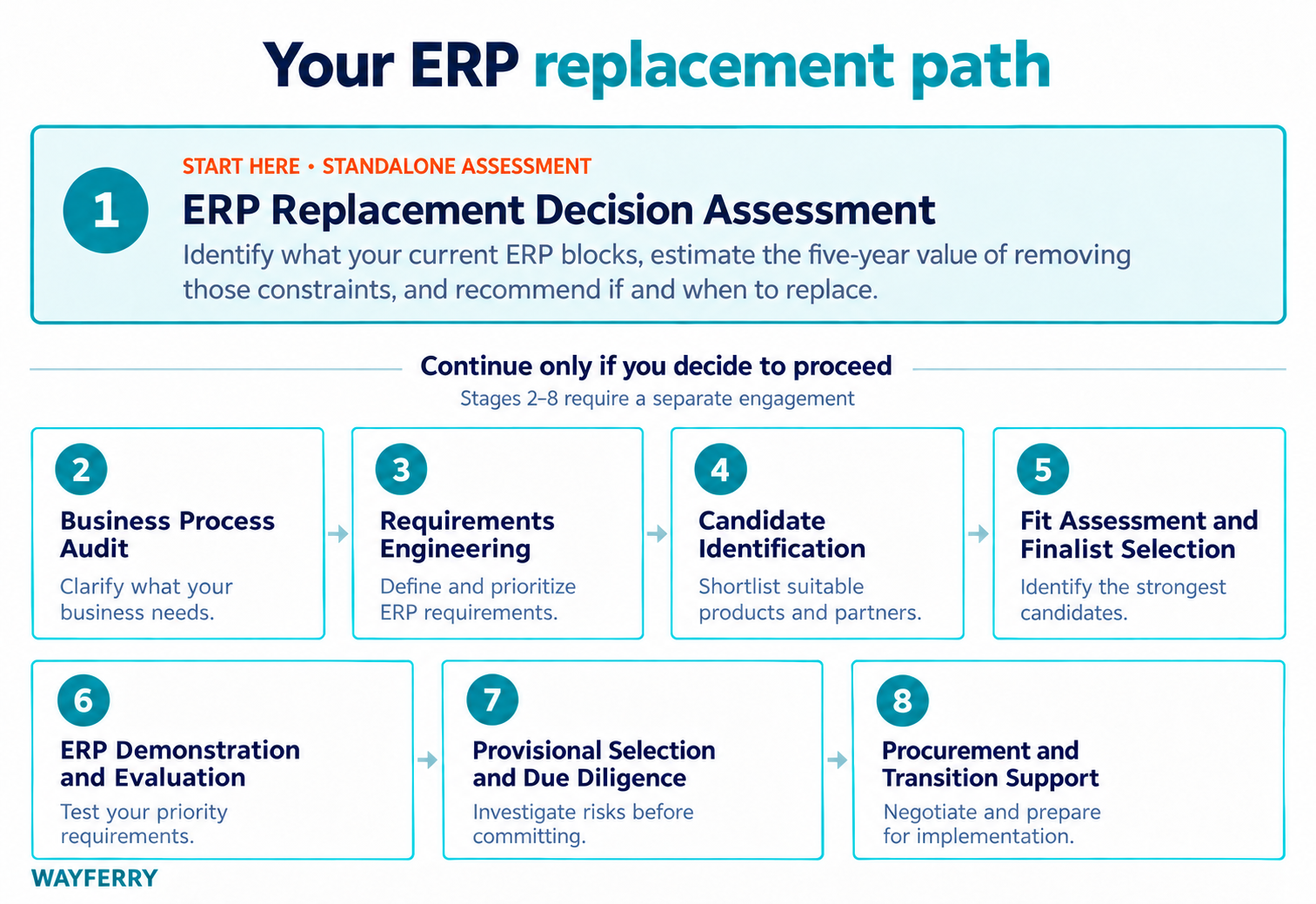
Wayferry helps your leadership team answer three questions:
What is being held back? Which strategic objectives and business goals does your current ERP constrain?
Could you improve what you have? Would changes to the current system, processes, or use of the software adequately address those constraints?
Is replacement worth it, and when? Does the potential five-year value justify the cost and disruption, and what needs to happen before you proceed?
Your team supplies and validates the financial and operational estimates. Wayferry structures the assessment and makes the evidence, assumptions, and uncertainties explicit.
Leave with a recommendation your leadership team can act on
The ERP Replacement Decision Assessment gives your leadership team a business rationale for deciding whether to improve your current ERP, replace it, or wait.
Executive participation: A 90-minute meeting with your CEO and CFO to discuss strategy, business goals, and current ERP constraints. Other executives may participate where their input would be useful.
What we need: Your strategic objectives, business goals, examples of current-system constraints, and available financial and operational information. Together, we identify gaps and make assumptions explicit.
What we assess: Whether ERP replacement is justified, the alternatives, the potential five-year value of addressing constraints, and the costs, risks, and prerequisites that affect the decision.
Preparation: Share your strategic objectives, business goals, and available examples of ERP constraints before the meeting. We agree on the information needed and your team’s participation before the engagement begins.
What you receive: An ERP Replacement Decision Brief documenting the evidence, financial assumptions, recommendation, and practical next steps.
The assessment recommends one of four paths:
Keep the current ERP
The evidence does not justify replacement. Focus on appropriate improvements to the current environment.
Replace later
Replacement may become necessary. Set a date to revisit the decision and define what would trigger action.
Prepare before replacing
Replacement is justified, but prerequisites need attention before the project proceeds.
Proceed now
The evidence supports moving forward. Establish the business outcomes, scope, and priorities that will guide evaluation and selection.
A 90-minute executive meeting. Your Decision Brief is typically delivered about two weeks afterward.
Independent advice, grounded in your business
Wayferry does not sell, configure, or support ERP software. We provide independent advice and can manage implementation on your behalf, while your software vendor and implementation partner deliver the system. We are paid by our clients and receive no software or vendor commissions.
We examine the case for replacement alongside the viability of improving your current environment. Any recommendation to replace ERP must be supported by documented business evidence, assumptions, and financial reasoning.
The assessment’s value is helping you make a sound decision, whether or not you pursue a replacement project.
Already decided to replace your ERP?
Define what success requires before choosing software.
Without clear, prioritized requirements, impressive demonstrations can conceal gaps that emerge during implementation. Wayferry helps you understand what your business processes must accomplish, preserve competitive advantages, and define what the software and implementation must deliver. Those requirements provide the basis for comparing candidates and verifying vendor claims before you buy.
A client’s experience with ERP selection
Uncover requirements your team might otherwise miss
IntraPac’s CFO described how Wayferry’s requirements library helped identify ERP needs the company had not recognized.
“Their libraries contained many ERP requirements we didn’t know we needed.”
Our reusable requirements library helps uncover needs your team might otherwise overlook. We work with your team to tailor and prioritize requirements around your business processes and goals, then use them consistently for evaluation, selection, and implementation planning.
We help you:
Audit your business processes. Capture all regular business processes. Identify processes suitable for standardization and flag those that differentiate your business.
Preserve competitive advantages. Identify the distinctive processes that help your business win and why they create an advantage. Define what your new ERP must support so vendor-standard “best practices” don't replace valuable differentiation just to make implementation easier.
Define and prioritize requirements. Tailor our hierarchical requirements library to specify the business capabilities your processes need and what implementation must deliver, including data migration, integrations, training, and cutover. Use these requirements to guide software evaluation, define implementation scope, and plan user acceptance testing.
Compare ERP products and implementation partners against your requirements.
Verify vendor claims through structured demonstrations and documented evaluation.
Support procurement and implementation readiness. Carry your requirements and evaluation findings into commercial negotiations, clarify scope and delivery responsibilities, and establish a clear handoff to implementation.
What clients gained from ERP selection
Crown Prince
Save time and focus on what matters
Crown Prince’s CFO credited Wayferry with identifying showstoppers and keeping the evaluation focused on the company’s key objectives.
“Using Wayferry saved months of work.”
Dante Valve
Make ERP selection thorough and manageable
Dante Valve’s VP of Operations credited Wayferry’s approach with making the company’s ERP evaluation and selection thorough, efficient, and successful.
“Thorough, efficient and ultimately successful.”
Keep implementation focused on what your business needs
Selecting an ERP is only the beginning. Implementation must deliver the business outcomes that justified your investment.
Wayferry’s Implementation Management and PMO service manages implementation on your behalf, carrying forward the requirements, findings, risks, and vendor commitments established during selection.
Control scope. Use detailed, hierarchical requirements to define agreed work, track changes, and assess their impact on business goals, cost, and timing.
Reduce omissions. Our reusable requirements library helps identify work that teams might otherwise overlook, including data migration, integrations, training, and cutover.
Track delivery commitments. Keep responsibilities, dependencies, decisions, and outstanding issues visible across your team and implementation partners.
Verify readiness. Use requirements to guide user acceptance testing and assess whether the system and other agreed deliverables are ready for go-live.
The requirements used to select your ERP become the foundation for managing its implementation.
Make your next ERP decision with a clear business rationale
Whether you are considering replacement or already preparing to select a system, start with the business outcomes you need to achieve.